
A sewer camera inspection helps Utah homebuyers review a sewer lateral for roots, offsets, buildup, standing water, and damaged sections.
A sewer camera inspection gives a Utah homebuyer a direct look at an important part of the property that sits out of sight. The camera can document pipe material, roots, buildup, standing water, damaged joints, and sections it cannot pass. It cannot promise that a future sewer problem will never occur. It does replace a blind spot with current facts before ownership changes hands.
Why the sewer lateral deserves its own review
The sewer lateral carries wastewater from the home toward the public connection or an onsite system. Much of that run is underground. A house can look clean and work normally during a walkthrough while the line has not yet shown an obvious backup.
A standard home inspection may review visible plumbing fixtures and parts without sending a camera through the sewer. Buyers should ask exactly what is included rather than assume the underground line was inspected.
This matters most when the home has any of these signals:
- A history of recurring drain cleaning or main-line backups.
- Mature trees near the likely sewer route.
- Older sections of clay, cast iron, or another aging material.
- A cleanout with signs of recent use.
- Several slow fixtures or gurgling at low drains.
- Planned remodeling that will increase plumbing demand.
None of those signals proves the line has failed. They make current video evidence more useful.
What the inspection process looks like
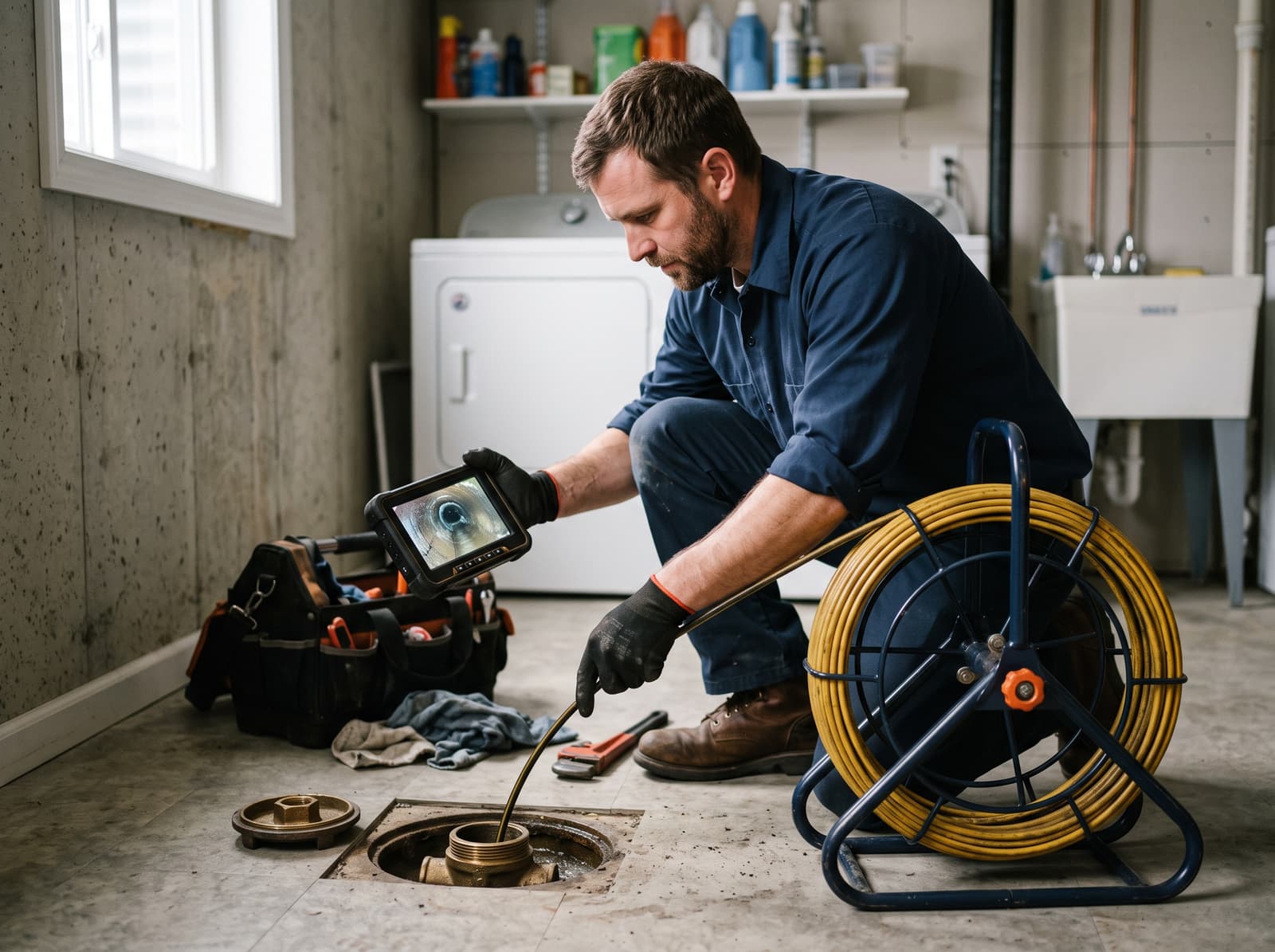
A technician begins at an entry point, often a sewer cleanout. The camera head moves through the line while the technician watches the video and notes distance. A locating tool may help mark a key finding at the surface.
Access matters. A blocked, sharply turned, collapsed, or heavily offset section may stop the camera. That limitation is itself a finding, but it means the entire route was not viewed. The report should say how far the camera traveled and what prevented further access.
If you do not know where the cleanout is, our guide to finding a sewer cleanout explains common locations around a Utah home. Do not open a backed-up cleanout cap casually. Wastewater can be standing behind it.
What a sewer camera can reveal
Roots entering through a joint or crack
Roots do not create an opening in a sound pipe simply because a tree is nearby. They take advantage of an existing joint, gap, or defect where moisture is available. The camera can show the entry area and whether the root mass is a cleaning problem, a repair problem, or both.
Offset, separated, or damaged joints
Pipe sections can lose alignment or separate. The resulting edge catches paper and debris, admits soil or roots, and creates a repeat blockage point. Camera footage helps distinguish that structural condition from ordinary buildup.
Standing water or a low section
Water that remains in a gravity sewer can indicate a belly, poor slope, or another flow restriction. The camera view has to be interpreted carefully because temporary water can have more than one cause. A consistent low section across a measured distance is different from a little water around an active blockage.
Buildup and obstructions
Grease, sludge, scale, roots, and foreign material can narrow the pipe. The video helps match the next step to what is visible. A sound line with buildup may need sewer line cleaning, while a defined break may call for repair.
Changes in pipe material
Some laterals contain more than one material because portions were replaced at different times. Transitions can be important inspection points. The report should describe what was visible without claiming the camera can identify every material with certainty from appearance alone.
What the camera cannot promise
A sewer camera records the inside of the pipe that it can reach at the time of inspection. It does not test every joint under load or measure soil support. It cannot prove how long the pipe will last or promise that a future clog will not occur. It may not pass through standing water, a collapse, or a tight turn.
It also should not be used to sell a predetermined repair. The value comes from connecting footage to the symptom, location, and practical options. A finding should be described in plain language. State what is visible, where it is, how certain the reading is, and what step would confirm the scope.
Questions a Utah buyer should ask about the footage
Do not settle for a verbal "looks fine" or "needs replacement" when video exists. Ask:
- Where did the camera enter, and how far did it travel?
- Was the public connection or end point reached?
- What pipe materials and transitions were visible?
- Were roots, offsets, cracks, standing water, or buildup present?
- Can the significant finding be located from the surface?
- Does the line need cleaning before a clearer inspection is possible?
- Is the plan to watch, clean, make a spot repair, or install a broader new line?
- Can you receive the video or representative still images?
These questions create a record that can be reviewed with the inspector, plumber, and real-estate professionals involved in the transaction.
City sewer and septic systems need different follow-up
Confirm whether the property connects to a public sewer or uses an onsite wastewater system. A camera of the building sewer does not replace a septic-system inspection. The U.S. Environmental Protection Agency publishes a new homebuyer's guide to septic systems. It explains why onsite systems need their own records and inspection process.
For a public-sewer property, clarify who owns each part of the lateral and where that duty changes. Rules can vary by water or sewer provider. The camera describes the pipe; the provider or city defines ownership and permit rules.
Use the findings to plan, not panic
A small amount of buildup does not always mean a new line is needed. Roots may call for cleaning and regular checks if the pipe is otherwise sound. A single located defect may fit a targeted repair. A collapse or damage across a long section may support a larger scope. The choice should follow the evidence.
If repairs are discussed, review the camera footage before selecting between a spot repair, sewer line repair or replacement, or another approach. Ask what condition rules each option in or out.
Add underground evidence to the buying decision
A sewer camera inspection helps Utah homebuyers understand a line before its care becomes their duty. It can reveal current problems, document a clean route, or show where more work is needed. It should be one source of facts within the broader home review.
If you are buying in Jetstar's service area, contact Jetstar Plumbing and Drains to schedule a sewer camera inspection. We serve Pleasant Grove, American Fork, Lehi, Orem, Provo, Draper, Sandy, and Salt Lake City. We can review the accessible line and explain what appears on the screen. The next step will follow the finding instead of a preset recommendation.
Need this handled?
See our sewer camera inspection service.